

How to Become Impossibly Well, Without the Snake Oil
On Wellthy Living, Epicurus, and the personal brand the wellness industry can't sell you

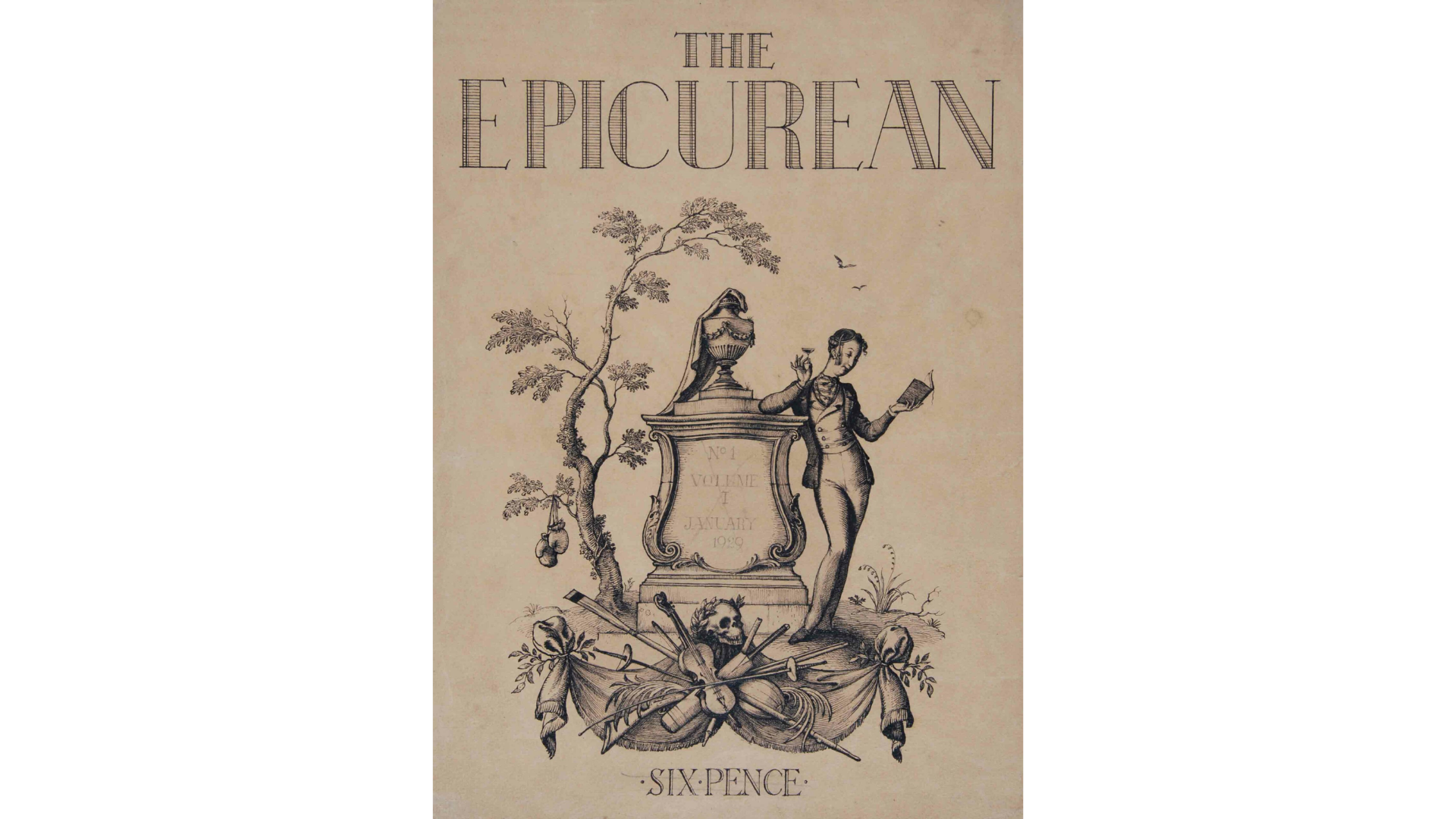
For two thousand years, the word epicurean has been used to describe the sensualist luxuriator and wine-soaked dinner host of extravagant appetites.
If you describe a meal as epicurean today, you mean something close to decadent. The word, in modern English, is more or less a synonym for hedonist and religious Jews use the word apikores to define a heretic.
This is almost impressively backwards. Epicurus himself was about as far from the wine-soaked dinner host as it is possible to get.

Epicurus, the Greek philosopher who lent the word his name, lived a life that, by the standards of contemporary wellness influencers, would look almost punitively spare. He dined on bread and water and only added a piece of cheese on feast days. He lived, deliberately, on the outskirts of Athens, in a property he called The Garden, with a small community of friends who shared meals, work, and resources in a manner so radical that contemporaries were scandalised. Women and enslaved people were admitted on equal terms, which was, in 306 BCE, the philosophical equivalent of starting a cult. He was, by all accounts, in considerable physical pain for most of his adult life from a chronic stone-related illness.
And yet, on the last day of his life, dying in considerable agony at the age of seventy-two, he wrote a letter to a friend describing the day as a truly happy one.
The thing that’s been forgotten in the modern misuse of his name is that Epicurus didn’t equate pleasure with indulgence. He equated pleasure with the absence of disturbance in the mind and body, what he called ataraxia. And he understood, with a clarity most modern wellness culture has lost, that this state is most reliably produced by the difficult, ordinary, daily practice of living well and within your means.
This is Wellthy Living and it’s easily the most subversive of all the personal brand Pleasure Codes.
This is the sixth of the eight personal-brand Pleasure Codes. Wilde, Barnum, Malcolm X, Roosevelt and Stein are already here, and two more are coming.
Upgrade to a paid subscription for access to the whole series and playbooks, along with the full Pleasure Codes Compass for turning desire into strategic advantage, the Seven Deadly Sins of Brand Building, and Pleasure Codes Plus, my brand innovation intelligence platform with thousands of examples, updated weekly.
What Wellthy Living Actually Is
Wellthy Living is the pleasure of body, mind, and spirit tuned to a single clear frequency. It’s the territory of high eudaimonia fused with the deeply individual, and slightly stubborn project of living so well that the visible state of your life becomes its own argument.
The trick of the name is the deliberate confusion of two ideas that have, in our culture, almost merged. Wellness, in the modern sense, has become a status symbol. The right supplements. The right water bottle. The right wearable.
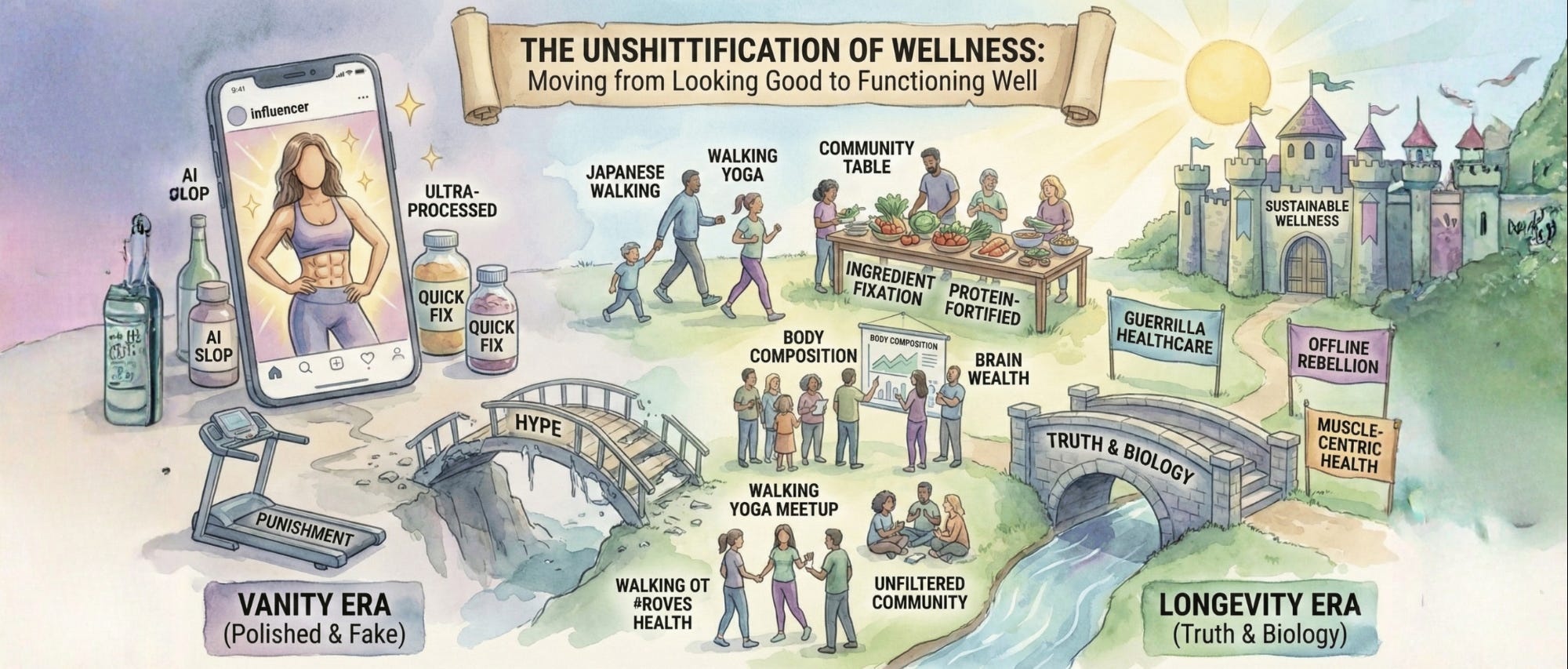
Wealth, meanwhile, has become a strange and exhausting performance, in which the actual texture of a wealthy life (the freedom, the time, the calm) has been almost entirely supplanted by its decorations.
Like the right Erewhon smoothie photographed in the right light.
Put together, Wellthy Living is the (somewhat impertinent) suggestion that these two ideas have got tangled, and that it is time to untangle them.
When you’re around someone whose personal brand lives in Wellthy Living, the experience is unmistakable, and pretty hard to fake because you feel that you’re with a person who has done the work. Their body looks like it has been built rather than purchased. Their attention is unhurried. Their answers to questions are short, useful, and slightly unflattering to whichever fashionable thing you just praised. They are, in some specific way, more there than the rest of us, and they have a way of making sure that you know that this “thereness” is the by-product of a thousand boring decisions made in the same direction over many years.
The drivers of a Wellthy Living personal brand are, I think, reasonably consistent.
The first is coherence between body and life.
Wellthy Living people look like the lives they actually lead. They do not have the bodies of people who have hired specialists to manufacture them. They have the hardened bodies of people who have, daily, for decades, chosen the harder thing.
The second is the discipline that never announces itself.
They’re, almost universally, not preachy. They’ve made peace with the fact that other people are not going to make their choices, and they’ve stopped needing them to. Which makes them, paradoxically (and they know this), far more contagious than the people who try to recruit you.
The third is the refusal of the shortcut.
The Wellthy Living personal brand sells, as its central proposition, the unfashionable observation that there is no hack. They are, in a culture saturated with a five-step cheat code, willing to be the person in the room who says, no, you actually have to do it for ten years.
The fourth, and most telling, is the genuine, slightly bewildered happiness.
But don’t mistake this for joy or exuberance. It’s more like the observable and settled sense of happiness of a person who has worked out a way to be at home in their own skin. And this is the thing that people attracted to Wellthy Living personal brands actually want. It’s also the thing that no amount of money can buy you in advance.
When all four engines run together, you get a personal brand that, in our current cultural moment, is wildly undersupplied and almost criminally underpriced.
You get a person who is, simply, well.
Why Epicurus Is the Real Poster Child
It is worth lingering on Epicurus, because his case shows the principle with unusual clarity, and because we have spent two thousand years getting him almost exactly wrong.
As I mentioned earlier, he founded The Garden in 306 BCE. Unlike Plato’s Academy, Aristotle’s Lyceum or Pythagoras’ cult, the Garden wasn’t set up as a school. It was more like an intentional community. The closest modern analogue is, perhaps surprisingly, an Israeli kibbutz where members who share a similar philosophy live together, share meals, keep a vegetable plot, and support one another’s work. The diet was simple bordering on austere. The conversation was philosophical but not pompous. Epicurus believed firmly that the purpose of philosophy was more practical (the relief of anxiety, the cultivation of friendship, the calm-eyed acceptance of mortality) than performative.
The trick he pulled, and the trick that defines every successful Wellthy Living personal brand since, is that he lived the philosophy in such visible and unhurried detail that it became its own marketing. His followers didn’t follow him because he had the most persuasive theory of pleasure. They followed him because, when they showed up at The Garden, the man and his small community looked like proof. Not rich. Not famous. Not lavish. Just, well. Which, in a city as politically frantic and emotionally volatile as Athens in the period after Alexander the Great, was a devastatingly convincing piece of evidence.

This is the central paradox of Wellthy Living as a personal-brand strategy. The work is invisible, but the result is unmissable. You can’t simply perform this kind of brand. Your personal brand and your actual way of living have to become almost identical. You live it every day, for long enough that other people begin to notice something is different. And when they ask, you tell them what you have been doing. Then they choose to believe you, or they don’t.
There is no shortcut around this part. Which is, in fact, the philosophy.
The Modern Business Case: Joe De Sena and the Mission to Get the World Off the Couch
Two and a half thousand years after Epicurus, the clearest modern example of a Wellthy Living personal brand is probably a Vermont-based former Wall Street commodities trader who founded an obstacle-course race because he was, by his own description, irritated.
Joe De Sena is the founder of Spartan Race, and depending on the day, a walking lawsuit, a cult leader, and one of the most consequential figures in contemporary fitness culture. He runs his life and his company from a working farm in Pittsfield, Vermont, where employees and guests are routinely required to wake at five, do burpees in the snow, chop wood, and, in one notorious office story, watch as De Sena walks across the room and throws away a box of doughnuts someone had brought in for a colleague’s birthday.
He is, in person, simultaneously charming and slightly terrifying.

Importantly, he doesn’t train apart from the people around him. He could, of course. He’s an extraordinary athlete with the resources to do anything he wants. But when he shows up at a race, he’s not there simply to manage the event or cheer from the sidelines. He runs it with the participants. He doesn’t just make you do burpees in the middle of a meeting. He gets down on the floor and does them with you.
What makes De Sena a Wellthy Living personal brand (and not a fitness influencer of the more familiar shouty variety) is the part most people miss. His favourite Spartan Race participants, he’s said many times, are the visibly unprepared people who turn up for the first time and walk the entire course. He admires them. He singles them out. He gives them (and not the elite athletes who finish first) his attention. The whole apparatus of Spartan Race exists to give those people the experience of having done something they did not believe they could do.
His stated mission is, characteristically grandiose: get a hundred million people off the couch.
This is the Epicurus move in modern dress.
And just like an Epicurus philosophy, there is no shortcut. Spartan races are expensive because Joe believes you should feel the sting as motivation. The work is hard but the result is visible. The brand is built on the proposition that ordinary humans, doing the unfashionable, repetitive, often-painful basics, will produce in themselves a quality of life that no amount of money can otherwise buy.
It’s worth noting that the Spartan Race brand itself is not a Wellthy Living brand. It is an OptiMe company brand. And the distinction between the personal brand of the founder and the company brand is instructive. The company sells optimisation. The man sells something deeper. And it is the two things together that make the experience for the audience so powerful. But it’s also an important reminder that your personal brand and your company brand do not have to live in the same Pleasure Code, and in cases like this one they very productively don’t.
To put it in Spartan terms (the Greek city-state not the rave), the world is full of people selling the sizzle and downgrading the state. The Wellthy Living personal brand is the rare figure who refuses to do this. They are, like the ancient Spartans, sometimes irritatingly, committed to selling you the state.
Wellthy Living vs. the Wellness-Industrial Complex
Wellthy Living is not the same thing as the wellness industry.
The wellness industry, in its current form, has become an extraordinarily efficient machine for selling the image of being well to people who feel unwell. The Goop candle. The Erewhon smoothie. The $500 weekly delivery of vegetables that could have been grown in a small back garden for free. The supplement subscription. The wearable that tracks the sleep you are anxious about because you can see how badly you are sleeping. The recovery boots. The infrared sauna. The cold plunge timed by an app notification.
None of these things is inherently bad. Some are genuinely useful. But the brand of wellness that has emerged around them is doing something rather different from what Epicurus or Joe De Sena are doing. It’s selling the status of wellness as a product. It’s the costume without the practice. Or to put it in De Sena terms, it is the sizzle being marketed while the steak is downgraded.
This makes the test, for any personal brand considering Wellthy Living, brutally simple: is your audience walking away healthier, or just better decorated?
Take Gwyneth Paltrow, for example. Her company Goop is a superficial Wellthy Living brand and remarkably successful merchant of decorations.

It offers the candles, the gummies, the serums, the total lifestyle, packaged. But after a while, the effect isn’t necessarily greater wellbeing. It can be more monitoring, more purchasing, more anxiety about whether your body, home, pantry, skin, hormones, and sleep are optimised enough. The personal brand at the centre is selling the visible signs of wellbeing rather than the substance.
Stanley Tucci, by contrast, is operating much closer to genuine Wellthy Living. After cancer, recovery, and a period in which food itself became difficult, his public life now appears organised around restored appetite: travelling through Italy, talking to farmers, cooks, families, and producers, and treating a properly grown tomato as something worth paying attention to. He looks like a man whose life has recently been measured in days rather than years, and who is now spending the recovered time on things that actually contain pleasure.
The honest version of this requires that you publish the substance, not the signal. Which is, I should warn you, considerably harder than running a Goop. But it’s also considerably more durable, because the audience cannot, eventually, be fooled.
That’s the ultimate litmus test of a Wellthy Living personal brand. Are you doing the hard work and despite doing the hard work are you happy? If the answer is yes, then you are a personal brand in the space of Wellthy Living. If, however, you’re not doing the hard work but happy or doing the hard work and not happy then you are something else.
One Last Thought
When Epicurus was dying, in serious pain from the illness he had carried for years, he wrote a letter to his friend Idomeneus. The letter was short. It describes the day as blessed, despite the agony. It thanks him for their friendship and asks him to look after another friend’s children.
That’s the entire letter.
There’s no self-promotion. No advice. No system for how to die well.
And there’s a detail hiding in his name. Epicurus comes from the Greek epikouros: ally, or comrade. We turned it into a byword for private indulgence. His last letter, spent entirely on his friends, shows which meaning he actually lived.
Epicurus had spent forty years building a personal brand around the idea that a life properly arranged could produce calm even at the worst moment, and he had (in the worst moment of all) calmly verified the claim.
That’s the whole discipline. You build the life. You let the result show, in small ways, as you go. Eventually the texture of it becomes its own argument, and people start to ask. You tell them. Some try. A few stay.
The sizzle, in our culture, is everywhere. The steak is rare. The Wellthy Living brand is simply the visible commitment to being, against all current incentives, an example of the latter.
Which is why it may be the bravest of all the Pleasure Codes. And it is, I suspect, the one our particular moment in history is most hungry for.
— Angelique
PS: If you’re ready to go deeper, here’s the Wellthy Living Playbook.
just excellent work. thought provoking and wise. thanks for the work you do. you made me feel impossibly well!